How Does a Bee Waggle Dance Point to Nectar?
As an Amazon Associate we earn from qualifying purchases.
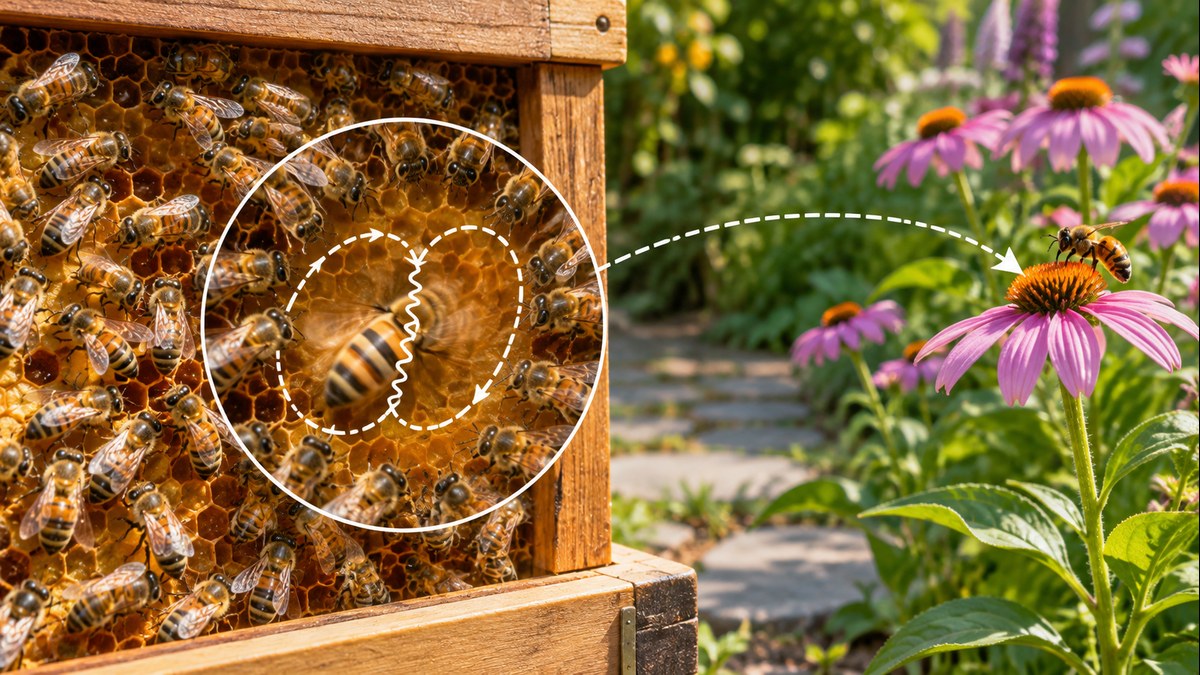
How does a bee waggle dance point to nectar? A honeybee that has found a good flower patch returns to the hive and performs a dance on a vertical comb surface. The dance tells nestmates which direction to fly, how far to go, and how rich the food is. This article explains how a bee waggle dance points to nectar, using the mechanism described in two PubMed Central articles on honeybee dance communication.
Quick answer
- The angle of the straight waggle run on the comb gives the direction of the food relative to the sun.
- The duration of the waggle run and the number of waggles give the distance to the food.
- The dance rate rises when the nectar is better, so the dance also signals how profitable the source is.
Why the dance happens on a vertical comb
The dance takes place where the dancer cannot see the food or the sun. One of the articles describes the setting directly: “The dance is performed on a vertical surface inside the hive out of sight of the sun and surrounding terrain.” That constraint shapes the whole code. The dancer has only the comb surface and gravity as references, so the dance has to translate outside directions into angles measured from vertical.
The forager’s movements are the message. One of the articles introduces the activity this way: “To do this, the forager performs a repetitive sequence of movements, the so-called waggle dance, which is one of the most intriguing examples of complex animal behaviour.” The waggle run is the part of the dance that carries directional information, and it is the part recruits follow most closely.
The same article gives the scale of the discovery: “In the 1940s, Nobel laureate Karl von Frisch deciphered the code hidden in this seemingly senseless choreography performed on vertical honeycombs in the darkness of the hive” Von Frisch’s decoding is the basis for the rules that follow.
How the angle encodes direction
The direction code maps the sun onto the vertical. The article states the rule: “He found that the angle of the waggle run from the vertical is equal to the angle between the sun’s azimuth and the indicated food source outside the hive.” The bee does not need a compass in the hive. It uses the sun as a reference and records the food’s direction as an angle from the sun’s position.
The article gives a worked example: “If food is found 45° to the right of the sun’s direction, the waggle run will be oriented 45° to the right of vertical on the comb”. A dancer that waggles straight up the comb points to food in the same direction as the sun. A dancer whose run is tilted 45 degrees to the right points to food 45 degrees to the right of the sun.
The sun moves during the day, so the bee has to correct for the time. The second article explains the problem: “Because the sun’s compass direction may change by more than 40° within in an hour, the solar bearing rapidly becomes useless.” To solve it, recruits rely on a learned clock: “recruited foragers convert the solar bearing to a compass bearing by reference to a previously learned solar ephemeris function.” The same article says the ephemeris function “gives the location of the sun above the horizon panorama as a function of the time on the bee’s circadian clock.” A recruit therefore reads the angle on the comb, applies the time-of-day correction, and arrives at a compass direction.
For a related pollinator topic, see how to attract native bees, which covers the flowers and habitat that bees forage on.
How the duration encodes distance
Distance is coded in time rather than in angle. The first article states: “The distance to the target, a flower patch with abundant nectar or pollen, is encoded in the duration of the waggle run: the longer the bee waggles, the larger the distance of the food from the hive.” The second article gives a related statement: “The number of waggles and the duration of the waggle run are proportional to the distance of the source.”
How bees measure that distance is still under study. The first article notes that the older explanation was based on effort: “It was previously thought they do this by measuring the energy used as they fly”. That explanation ran into trouble. The article explains that “doubts emerged when it was found that distance estimation by bees could be manipulated by altering the number of landmarks between the hive and a food source, suggesting bees were counting landmarks encountered en route”. Later work points to visual motion as a cue: “Honeybees use optic flow to measure the distance of a food source.”
The distance signal is also affected by scenery. The first article reports that “bees flying 200 m over water hardly appeared to register an increase in travel distance, whereas the same increase in distance flown over land resulted in a substantial increase in perceived flight distance.” The dance therefore reports a perceived distance, which can differ from the distance flown.
How the dance signals nectar quality
The dance also tells nestmates how good the food is. The first article states: “We’ve learned that bees prefer high over low nectar concentrations because this is reflected in their dances.” The mechanism is a change in how actively the dancer dances: “When bees find better nectar, they dance more enthusiastically, that is, the number of dance circuits per minute increases”. The article summarizes the rule as “Dancing bees tune both duration and rate of waggle-run production in relation to nectar-source profitability.”
The relationship between sugar and dance rate is not a straight line. The first article cites a study with this finding: “However, Waddington (2001) found that the relationship between actual and perceived nectar quality is nonlinear.” It describes the curve as “a positive but decelerating relationship,” and gives an example: “an increase in sucrose concentration from 10% to 20% results in twice the difference in dance rate that an increase from 50% to 60% does.”
What recruits do with the dance
A recruit that watches the dance does not simply fly a stated line and stop. The first article describes the early behavior of recruits: “The recruits performed first a straight flight in approximately the compass direction indicated by the dance.” The second article examined whether recruits also use the dance as a location, rather than only as a flying instruction. Its conclusion reads: “We conclude that by following the dance recruits get two messages, a polar flying instruction (bearing and range from the hive) and a location vector that enables them to approach the source from anywhere in their familiar territory.” The same article summarizes its broader view: “The dance communication is much richer than thought so far.”
For the original question, this means a bee does not need a map of the food to be pointed toward it. The dance supplies a direction measured from the sun, a distance coded in the run, and a signal of quality coded in the dance rate. Together those pieces make up the message that points a nestmate toward nectar.
If you are planning plantings that support foragers, see how to build a bee house for nesting options for solitary bees, which is a different group from the honeybees described here.
How we chose
This article relies on two PubMed Central articles, both opened on 2026-10-28. Both are academic and non-commercial. No retail or product pages were used, and no product is recommended here. Each factual statement in the body is tied to a quoted passage from one of the two articles, and sentences that could not be tied to a quote were removed.
What we could not verify
The two articles cover the core mechanism, but several details could not be checked in this pair of sources.
What the sources do not say
The fetched text does not give a single fixed rule that converts waggle duration into a distance in meters for every landscape. The distance discussion is about how distance is estimated and how it can be distorted, not about one conversion. The sources also do not list every cue bees use on the outbound flight.
Frequently asked questions
Does a bee dance point toward the food directly?
Not in the literal sense. The dance points relative to the sun. One article states: “He found that the angle of the waggle run from the vertical is equal to the angle between the sun’s azimuth and the indicated food source outside the hive.” A recruit combines that angle with the time of day to work out the compass direction.
Why does the dance happen inside the hive?
The dance happens inside the hive because the comb provides a vertical reference, and the signal is given in the dark. The article describes the dance as “performed on a vertical surface inside the hive out of sight of the sun and surrounding terrain.”
How does the dance show that a flower patch is rich in nectar?
The dance rate changes with food quality. The article states: “When bees find better nectar, they dance more enthusiastically, that is, the number of dance circuits per minute increases”. This quality signal is separate from the direction and distance code.
Can a bee find the food from the dance alone?
The second article suggests the answer goes beyond a simple flying instruction. Its conclusion is: “We conclude that by following the dance recruits get two messages, a polar flying instruction (bearing and range from the hive) and a location vector that enables them to approach the source from anywhere in their familiar territory.”
Why is the sun-based code hard to use?
The sun moves during the day. The second article states: “Because the sun’s compass direction may change by more than 40° within in an hour, the solar bearing rapidly becomes useless.” Recruits therefore need a learned time-of-day correction, described as “a previously learned solar ephemeris function.”
Sources
- PubMed Central, article on honeybee dance communication and nectar-source choice (PMC449901), https://pmc.ncbi.nlm.nih.gov/articles/PMC449901/ (HTTP 200, opened 2026-10-28). Quotes used: “the forager performs a repetitive sequence of movements, the so-called waggle dance”; “The distance to the target, a flower patch with abundant nectar or pollen, is encoded in the duration of the waggle run”; “When bees find better nectar, they dance more enthusiastically”; “Dancing bees tune both duration and rate of waggle-run production in relation to nectar-source profitability.”
- PubMed Central, article on honeybee recruit navigation after dances (PMC10041085), https://pmc.ncbi.nlm.nih.gov/articles/PMC10041085/ (HTTP 200, opened 2026-10-28). Quotes used: “The dance is performed on a vertical surface inside the hive out of sight of the sun and surrounding terrain.”; “recruited foragers convert the solar bearing to a compass bearing by reference to a previously learned solar ephemeris function.”; “We conclude that by following the dance recruits get two messages”.