How Do Soil Viruses Infect Bacteria in the Ground?
As an Amazon Associate we earn from qualifying purchases.
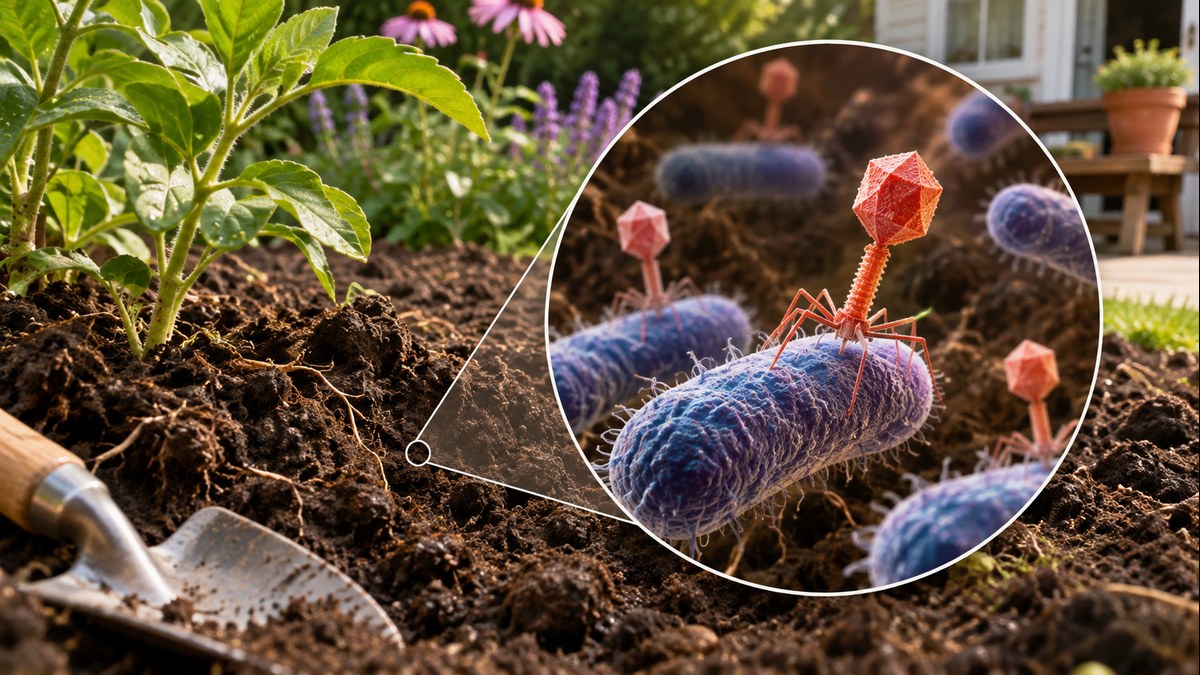
How do soil viruses infect bacteria in the ground? The viruses in question are bacteriophages, usually called phages, and the sources describe them as “infectious biological agents that only replicate within prokaryote cells using host cellular machinery.” Infection depends on conditions, as the sources show. A phage has to reach a bacterium and attach to it, and the water around the cells sets the chemical conditions for that attachment. This article explains the mechanism step by step, using two peer-reviewed PMC sources, and it separates what those sources show from what they only propose.
Quick answer
- Soil phages need a host bacterium, and the attachment step is the one most affected by the surrounding water. The first source states that “these cations interact with phage tail fibers to disaggregate them and enable phage binding to host cell surface receptors.”
- Dissolved ions matter for infection. The source reports that “Ionic strength is critical for infection of bacteria by many phages,” and that the “major divalent alkali earth metals” found in natural waters enable lytic infection.
- Infection is most favored in pockets where ions are concentrated, such as during drought or in biofilms next to recently burst cells. The source proposes “a model in which phage infection is most favored when ionic strength is locally or transiently elevated.”
- The field evidence is still uneven. The first source says that “results are variable and apparently context-dependent.”
What a soil phage is
A phage depends on a host for its own reproduction. The second source puts it directly: phages “only replicate within prokaryote cells using host cellular machinery.” In practice, the bacterium supplies the machinery and the phage uses it to make copies of itself. That dependence is the reason the question is about conditions in the ground rather than about the virus alone.
The sources also describe how strongly phages can act on their hosts. “Lytic phages can be potent and selective inhibitors of microbial growth and can have profound impacts on microbiome composition and function.” The source’s word lytic names the infection pattern that the rest of this article focuses on.
Phages are also widespread. The first source states that “Bacteriophages are ubiquitous in natural microbial communities and can play important roles in modulating microbial element cycling.” That sentence links phage activity to nutrient cycling, which is why their behavior in soil matters beyond the bacteria themselves.
Why soil is a harder place to study
Marine research gives a clearer picture than soil research does. The first source gives a marine figure: “In marine environments, phage lysis is responsible for ~40–50% of all bacterial mortality.” It then contrasts that with land: “In terrestrial systems, however, the contribution of phage to element cycling dynamics is much less well characterized and appears to be more variable.”
The soil evidence is mixed. “While some studies have attempted to demonstrate an impact of phages on soil element cycling, results are variable and apparently context-dependent.” The same source also says that “there is uncertainty about the biogeochemical conditions under which phage predation modulates microbial ecosystem function, particularly in terrestrial systems.” Those two statements explain why the simple question has a complicated answer. The mechanism depends on conditions that can change from one pocket of soil to the next.
The ion requirement for attachment
The most specific mechanism in the first source concerns ions. “Ionic strength is critical for infection of bacteria by many phages.” The source adds historical context: “It has been known for nearly a century that certain alkali metals and alkaline earth metals including calcium, sodium and magnesium are important for phage infectivity.”
The reason is structural. The source explains that “these cations interact with phage tail fibers to disaggregate them and enable phage binding to host cell surface receptors.” In plain terms, ions help the phage’s attachment structures separate and grip the bacterial surface. The effect is on the phage’s ability to bind, so it is a different step from the bacterium’s own growth.
The source describes “the model interaction between T4 and MS2 phages and E. coli hosts.” Within that model, it reports that “the major divalent alkali earth metals (Ca 2+ and Mg 2+ ) and monovalent alkali metals (K + and Na + ) found in natural waters enable lytic infection by T4 and MS2.” Those are the ions that the model treats as relevant to natural water.
Freshwater, biofilms and the infection window
Ion levels differ across habitats. The source suggests that “the low ionic strength in many freshwater environments may limit successful lytic phage infection” for the phage and host pairs it studied. The contrast is with other settings, where, according to the same source, “in biofilms adjacent to recently lysed cells or in estuarine/marine environments, ionic strength is not a limitation on these phage:host interactions.”
The biofilm case is the most direct link to soil in these sources. The second source names soil directly: “In structured environments like biofilms and soil aggregates, the spatial heterogeneity of resources and redox conditions gives rise to diverse metabolic states, which in turn modulate phage susceptibility.” Within a biofilm, the first source offers a mechanism that can keep infection going: “In bacterial biofilms, diffusion of ions from the cytoplasm of bacterial cells lysed by phage will locally maintain sufficient ionic strength for infection of new hosts.”
Put simply, a cell that has been lysed can release ions into its immediate surroundings, and those ions can keep the local water above the level that allows the next phage to attach. This is a local loop, not a whole-soil rule, because the source describes it as diffusion from cells.
How drought changes the ion picture
Drought is the soil condition that the sources connect most directly to ion levels. The first source states: “During drought, ionic solutes in soil pore water are concentrated until the solubility constants (Ksp) for insoluble inorganic compounds are exceeded.” Concentration is what pushes ions toward the thresholds that the model needs.
The behavior is not the same for every ion. The source explains that “Na + and K + salts are much more soluble and as such, the concentration of these ions will increase linearly with the concentration factor.” It also notes that in many freshwater systems “the formation of magnesium silicates and calcium carbonates limit solubility” of calcium and magnesium. Sodium and potassium therefore keep rising as water evaporates, while calcium and magnesium follow a different pattern.
From these observations, the source proposes a model: “phage infection is most favored when ionic strength is locally or transiently elevated.” The word proposes matters here. The source presents this as a model that it proposes, not as a measured rule.
Soil patterns that fit the model
Field data point in the same direction, although they do not prove the mechanism. The first source reports that “Metagenomic surveys of soils suggest a strong influence of soil moisture on viral ecological dynamics.” It also notes that “a strong distance-decay relationship was observed in similarity between viral populations across a grassland field site.” Viral populations that are farther apart tend to differ more, according to the distance-decay finding.
The source presents these observations as support: “Some recent field observations are consistent with our model.” That is a description of consistency, not confirmation. For readers who want the plant side of soil microbe activity, the article on how soil microbes cycle nitrogen covers a different part of the same ecosystem.
Competition from other bacteria also matters. The source states that “the enrichment of non-host bacteria will decrease the probability of productive phage:host interactions.” In its own enrichment cultures, the source reports that when Sulfurospirillum or Klebsiella were enriched, “the predatory efficiency of the Escherichia and Citrobacter phage was decreased as well as the phage impact on DNRA activity.”
Growth state and infection
The second source adds a cell-level constraint. “Phages are known to preferentially infect actively growing cells, as successful replication often depends on access to abundant nucleotides, ATP, and intact translation machinery.” The consequence is stated directly: “nutrient-limited or slow-growing cells often evade lytic infection.” A bacterium that is short of resources is therefore less likely to be infected in the lytic way, according to that statement.
Some infections follow a different path. “Temperate phages integrate their genomes into host chromosome as prophages in lysogenic cycles.” The source notes that “Prophages are prevalent in bacterial genomes and can constitute 10 to 20% of the host genome.” It contrasts this with “active lytic replication,” which is the path that the ion discussion above is about.
The effect reaches soil chemistry as well. The second source states that “In soil systems, viral predation and lysogeny alter nitrogen availability and microbial carbon use efficiency.” The sources do not give a soil-specific percentage for how often infection changes these processes, so this article does not estimate one. For the plant side of that chemistry, see why soil microbes help plants grow.
How we chose
Both sources are PMC articles that opened directly with HTTP 200 on the check date. The first has the title “Geochemical constraints on bacteriophage infectivity in terrestrial environments,” which matches the ion question. The second has the title “Bacteriophage-driven microbial phenotypic heterogeneity: ecological and biogeochemical importance,” which covers the cell-level and ecosystem questions. Neither is a retail page, and each was read as text before any statement was drawn from it.
What we could not verify
The sources explain a mechanism, but they do not provide a complete soil-scale measurement. The clearest gap is stated in the second source: “Despite these advances, the functional implications of phage-induced phenotypic heterogeneity remain only partially resolved.” Several parts of the chain described above therefore remain at the level of model or proposal.
What the sources do not say
The ion thresholds come from specific phage and host pairs, and the first source limits its freshwater proposal to “the Enterobacterial phage host:pairs we studied.” No excerpt gives a general threshold for every soil type. The second source also states that “the extent to which such heterogeneity influences microbial interactions, resource partitioning, and emergent community dynamics is still poorly characterized,” so the wider effect on soil communities is not settled.
Frequently asked questions
Are soil viruses that infect bacteria called phages?
Yes. The sources use the term phage for viruses that infect prokaryotes. The second source describes phages as “infectious biological agents that only replicate within prokaryote cells using host cellular machinery.”
Do ions really affect whether a phage can infect a bacterium?
The first source says that “Ionic strength is critical for infection of bacteria by many phages.” It links specific ions to binding through “phage tail fibers” and “phage binding to host cell surface receptors.”
Does drought make phage infection more likely?
The sources connect drought to ion concentration. The first source says that “During drought, ionic solutes in soil pore water are concentrated.” The source frames the link to infection as a model, in its words “a model in which phage infection is most favored when ionic strength is locally or transiently elevated.”
Can phages infect bacteria that are growing slowly?
The second source says that “nutrient-limited or slow-growing cells often evade lytic infection.” Slow-growing bacteria are therefore less likely to be infected in the lytic way, but the source does not put a number on the effect.
Does this explain every soil phage event?
No. The first source says that “results are variable and apparently context-dependent.” The ion mechanism describes conditions under which attachment is more or less likely, and the sources do not present it as a universal explanation for every event in soil.
Sources
- Carlson HK, Mutalik VK, et al. “Geochemical constraints on bacteriophage infectivity in terrestrial environments.” doi:10.1038/s43705-023-00297-7. https://pmc.ncbi.nlm.nih.gov/articles/PMC10439110/ (HTTP 200, opened 2026-10-28)
- “Bacteriophage-driven microbial phenotypic heterogeneity: ecological and biogeochemical importance.” https://pmc.ncbi.nlm.nih.gov/articles/PMC12095545/ (HTTP 200, opened 2026-10-28)