Why Do Lawn Grasses Form Tillers?
As an Amazon Associate we earn from qualifying purchases.
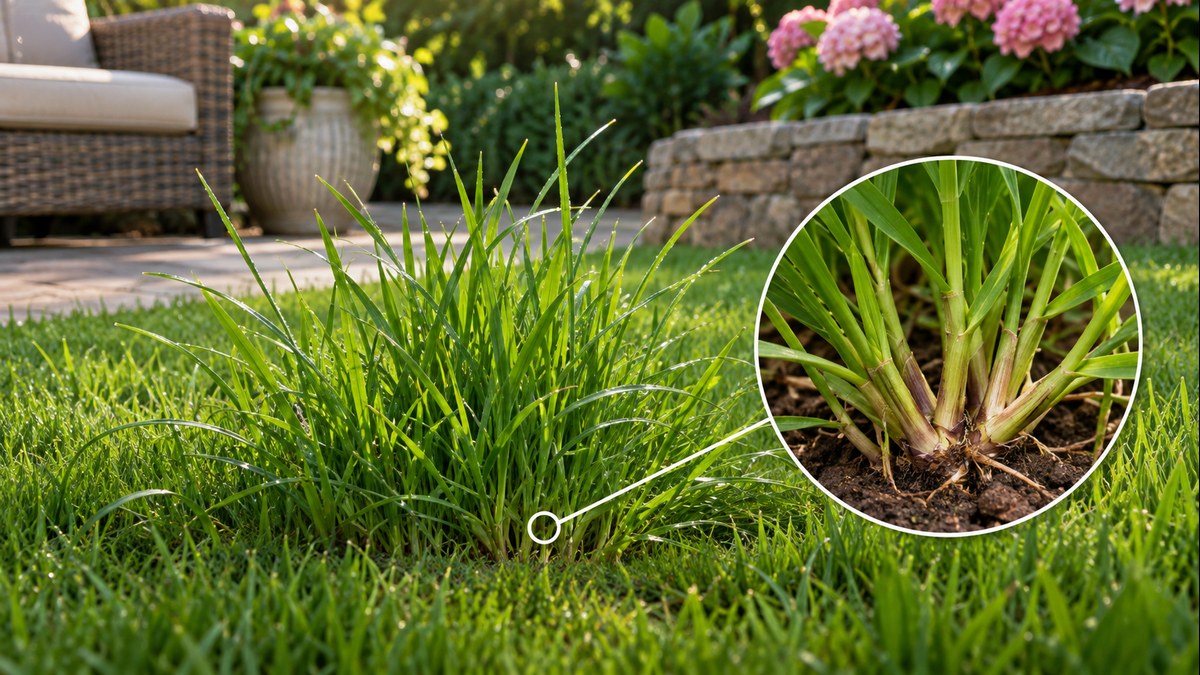
Why do lawn grasses form tillers? A tiller is a side shoot that grows from a bud near the base of the plant, and it is how many turfgrasses thicken over time. The University of Tennessee mowing sheet puts it simply: “Tillers develop from buds near the base of each plant.” The sources below explain where those buds sit, what turns them on, and why trimming changes how many tillers a lawn produces. They also mark what the research does not settle.
Quick answer
- Tillers are side shoots from buds at the base of the plant. The Tennessee sheet states that “Tillers develop from buds near the base of each plant.”
- The buds sit on the basal nodes. A plant physiology review says “In grasses, the basal nodes are the ones from which tillers arise.”
- Trimming can release more buds. A 2024 study reports that “trimming has been found to induce tillering in turfgrass.”
- Growth habit decides how a grass spreads. The Tennessee sheet says “Turfgrasses that primarily expand by tillering have a bunch-type growth habit.”
What a tiller is
A tiller is a branch that grows from the base of a grass plant instead of from a runner or a seed. The plant physiology review by Paula McSteen describes the general process, stating that “During vegetative development, axillary meristems give rise to branches, called tillers in grasses, while during reproductive development, axillary meristems give rise to flowering branches or to flowers.”
For a lawn, the practical result is density. The Tennessee sheet notes that “The turfgrasses usually become very compact and dense when routinely mowed.”
Where tiller buds sit
Tiller buds are not spread evenly up the stem. They form at the nodes near the ground, which is where the plant can be cut without losing the growing point. The McSteen review says that “In grasses, the basal nodes are the ones from which tillers arise.” The Tennessee sheet makes the same point from the lawn side, stating that buds “on nodes near the soil surface enable turfgrasses to tolerate mowing.”
The Tennessee sheet ties this position to mowing tolerance, as quoted above, and the two statements describe the same lawn grass from different angles.
What turns the buds on
A bud near the base does not always grow. The McSteen review uses rice as its main example and says that “In rice ( Oryza sativa ), axillary meristems grow out to produce a highly tillered plant, though the buds are still under hormonal and environmental control.” In other words, the buds are present, but hormones and the environment decide whether they become shoots.
The 2024 study on bermudagrass gives a closer look at one hormone pathway. Its authors report that “exogenous application of H 2 O 2 significantly increases the number of tillers after trimming by affecting the expression of cytokinin-related genes.” The result points to a hormone link between trimming and new shoots. The study is about one species, so it shows the pathway in bermudagrass rather than in every lawn grass.
How trimming changes tillering
The 2024 study measured the effect directly. It states that “Our study unveils the significant impact of trimming on promoting the sprouting and growth of tiller buds in stolon nodes, along with an increase in the number of tillers in the main stem.” The authors describe two effects here: buds at the nodes start to sprout, and the main stem produces more tillers.
Trimming also changes the energy balance of the new shoots. The same study says that “the partial trimming of new-born tillers results in an increase in sucrose and starch reserves in their leaves.” The energy described in the study comes from the reserves stored in the new leaves.
The effect is not unlimited. The Tennessee sheet says that “Each turfgrass has a preferred or optimum mowing height range.” The sheet’s height guidance is the reference point for that range.
Bunch and sod grasses
Not all lawn grasses spread the same way. The Tennessee sheet states that “Turfgrasses that primarily expand by tillering have a bunch-type growth habit.” Bunch grasses fill a lawn by thickening in place. Sod-forming grasses spread in a different way, and the sheet notes that “Turfgrasses with a sod-forming growth habit may tolerate a much lower mowing height and produce more thatch than those with a bunch-type growth habit.”
The McSteen review adds that rhizomes are a separate route. It says “Tillers grow out from rhizomes beneath the soil surface,” which shows that a plant can produce shoots from underground stems as well as from basal buds. A lawn grass can therefore fill gaps by tillers, by rhizomes, or by both, depending on the species.
Why this matters for a lawn
The sources support three practical points: buds sit at the base, trimming can release them, and each species has its own preferred height. Keeping the cut within that range is the practical step the sources support.
Grass clippings are a related question. A separate guide covers that topic in more depth at whether grass clippings belong in the garden. Leaves are another option for mulch, covered in how to make mulch from leaves and grass. This page stays with the plant side of the question: why the shoots form and what makes them grow.
How we chose these sources
The three sources were picked for different reasons. The Tennessee sheet is a university extension publication on turfgrass mowing. The 2024 study is a peer-reviewed paper on tillering in bermudagrass. The McSteen review is a plant physiology review on branching in grasses. Each source was downloaded, checked for HTTP 200, and quoted from its own text.
The sources cover the lawn side, the experimental side and the mechanism side. Using all three gives a fuller answer than any one of them, and it keeps the guide honest about where the evidence is strong and where it is thin.
What we could not verify
The three sources answer the mechanism question, but they do not settle every lawn decision. The limits below come from the sources or follow from their scope.
What the sources do not say
The bermudagrass study is about one species. Its authors write that “the role of H 2 O 2 in trimming-induced tillering in bermudagrass, a kind of turfgrass, remains unclear” before they run their own experiments. The results describe bermudagrass and should not be assumed to hold for every lawn grass.
The McSteen review uses rice as its main example of hormonal control, so the hormonal detail comes from a crop rather than a lawn species. The sources do not give a single mowing height that produces the most tillers in every lawn. The Tennessee sheet says only that “Each turfgrass has a preferred or optimum mowing height range.”
Frequently asked questions
Do all lawn grasses form tillers?
No. The Tennessee sheet describes the bunch-type habit, saying that “Turfgrasses that primarily expand by tillering have a bunch-type growth habit.” Sod-forming grasses spread in a different way, so the answer depends on the species.
Does mowing create more tillers?
The 2024 study says that trimming can increase tillering. It reports “an increase in the number of tillers in the main stem” after trimming. The effect was measured in bermudagrass, so the same result may not apply to every lawn grass.
What do new tillers need to grow?
The 2024 study says that the trimming response helps “boost energy supply and maintain the redox state in newly formed tillers.” Sugar and starch reserves in the new leaves support that early growth.
Why do tiller buds sit near the soil?
The Tennessee sheet says that buds “on nodes near the soil surface enable turfgrasses to tolerate mowing.”
Are hormones involved in tiller growth?
Yes, according to the sources. The McSteen review says that the buds “are still under hormonal and environmental control.” The 2024 study links trimming-induced tillering to “cytokinin-related genes.”
Sources
- Samples, T., and Sorochan, J. Turfgrass Maintenance: Mowing. University of Tennessee Extension, W161-I. https://uthort.tennessee.edu/wp-content/uploads/sites/228/2023/11/W161-I.pdf
- Li, S., Yin, Y., Chen, J., Cui, X., and Fu, J. H2O2 promotes trimming-induced tillering by regulating energy supply and redox status in bermudagrass. PeerJ, 2024. https://pmc.ncbi.nlm.nih.gov/articles/PMC10909351/
- McSteen, P. Hormonal Regulation of Branching in Grasses. Plant Physiology, 2009. https://pmc.ncbi.nlm.nih.gov/articles/PMC2613715/


