DonSail 35-65 Inch Fruit Picker Pole Review
As an Amazon Associate we earn from qualifying purchases. Details
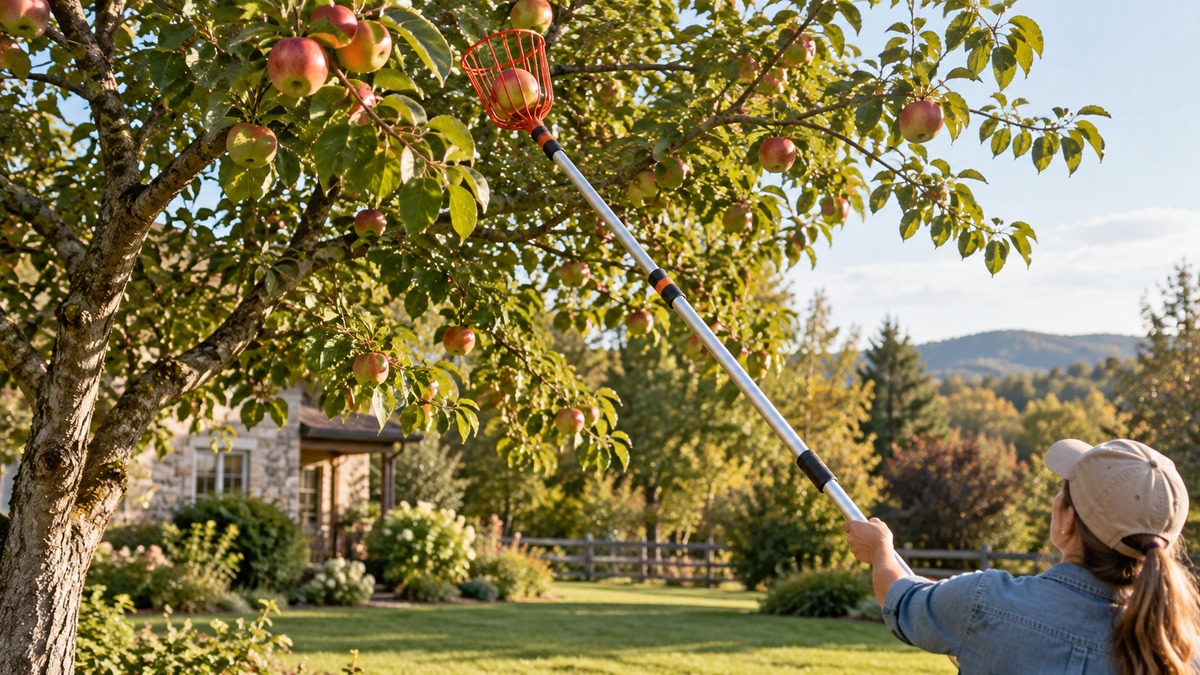
The DonSail fruit picker pole is a hand tool: a stainless steel pole with a metal basket on the end, sold in an adjustable length from 35 to 65 inches. It suits picking fruit from low and medium branches in a home garden, where you can reach the fruit from the ground. It does not suit high branches, cutting, or heavy fruit, and any metal pole near an overhead line needs the clearance rules covered below. This review is built from the listing text and three safety sources.
Quick answer
- The pole extends to 65 inches, which is about 5.4 feet. Count the height of the fruit you want, not the height of the tree, and check that the fruit sits within the pole’s reach from where you stand.
- The listing gives no load rating for the basket, and it does not say how much fruit the basket holds safely.
- Keep the pole at least 10 feet from any overhead power line. The safety sources below treat every overhead line as live until the utility confirms otherwise.
- The listing gives a five-year manufacturer warranty from the date of purchase, and no other warranty detail is given in the fields the listing shows.
The listing at a glance
The table gives only what the listing states. Where a field is missing, the cell says so.
| Field | What the listing states |
|---|---|
| Brand and model | DonSail, adjustable fruit picker pole with basket, black, classic style |
| Length | Adjustable in sections to 35, 40 or 65 inches |
| Material | Stainless steel; 1-inch diameter per a bullet |
| Basket | Metal twist-on basket and claw head, about 9 by 5.5 by 5.5 inches; foam pad at the bottom; 57.65 fluid ounces |
| Item weight | 16 ounces (1.0 pound) |
| Assembly | About five minutes, with no extra tools, per the listing |
| Warranty | 5 years from the date of purchase, per the listing |
| Load rating | Not stated |
| Fruit list | A long list of fruits, including apple, avocado, mango, pear and orange; no ranking of which suits the basket best |
Reach: the length arithmetic
The pole has three set lengths, and the reach you get depends on the length you set and how high you can hold the pole. Converting to feet makes the comparison easier, because most fruit heights are measured that way.
| Length set | Inches | Feet (inches divided by 12) |
|---|---|---|
| Shortest | 35 | 2.92 |
| Middle | 40 | 3.33 |
| Longest | 65 | 5.42 |
The basket’s height above the ground is roughly the height of your hand on the pole plus the pole’s length, when the pole is held upright with the basket at the top. The formula is basket height = hand height + pole length. The listing does not describe the basket’s own height, so this is a planning figure, not a measured one.
Before you buy, measure two things: the height of the lowest and highest fruit you want to pick, measured from the ground, and the height you can reach with the pole held out and up while you stand on level ground. Subtract your reach from the fruit height to find the pole length you need. For example, fruit at 9 feet with a reach of 4 feet would need a pole about 5 feet long. The 65-inch setting, at 5.42 feet, covers that. The 4-foot reach is an example, not a measurement of anyone, so do the subtraction with your own numbers.
Worked example: fruit 10 feet up
Say the fruit you want sits 10 feet above the ground. At the longest setting, the pole adds 5.42 feet above your hand. Rearranging the formula, your hand needs to be at 10 minus 5.42, which is 4.58 feet, or about 55 inches above the ground, to reach that height with the pole upright.
Fruit higher than that needs the pole to be fully extended and the basket placed beside the fruit, not under it. For fruit near 8 feet, the same formula gives a hand height of 2.58 feet, or about 31 inches, which is low enough that most people can hold the pole and still control it. These are planning figures from the listed lengths, not measurements of any tree.
The listing gives no load rating for the basket. The basket’s listed capacity is 57.65 fluid ounces, which is about 1.7 liters. That is a volume, not a weight limit, so a basket full of heavy fruit may tip or bend the pole. The listing does not say what it can carry.
Power lines come first
A fruit picker pole is a long metal object, and the basket is at the top. Any contact between a metal pole and an energized line can electrocute the person holding it, so the clearance rule decides whether the pole should be used at all near a tree that grows under or beside a line.
The New Jersey FACE report, dated August 21, 1998, sets the basic distance. It says a minimum clearance of 10 feet must be kept between equipment and power lines, and it cites the federal construction and general-industry rules that set 10 feet for lines up to 50,000 volts, with greater distances for higher voltages. That report is more than 25 years old, so the current federal text should be checked before you rely on any figure in it.
The Trico electric cooperative brochure, a 2025 safety document, gives the same 10-foot rule and advises treating every overhead line as energized until the utility confirms otherwise. It also says to call the utility when you are not sure of the voltage, and it advises nonconductive ladders when working on or near lines. A metal pole raises the same concern as a metal ladder, so the brochure’s advice applies to this pole too.
Michigan State University’s hazard alert on overhead power lines, published February 27, 2026, tells workers to look up and locate every line before starting work. Its table lists 20 feet for metal ladders near lines under Michigan’s standard, which is a state rule that may not apply where you live. Read it as a stricter example, not as the rule in every state.
In practice: stand clear of the pole’s path before you raise it, look for lines overhead before you start, do not work under lines, and if a line is close to the tree, pick the fruit another way or call the utility first. The safety decision comes before any question about reach.
Basket and handling
The listing describes the basket as bowl-shaped, with a foam pad at the bottom to reduce bruising when fruit lands. It says the pole is made of commercial-grade stainless steel with a 1-inch diameter, and that it is easier to maneuver than wooden poles. Those are the manufacturer’s claims. The listing does not give the wall thickness of the tube, the joint design or the stiffness of the pole at full extension, so those points should be checked on the product page or in the instructions before you rely on the pole for heavy use.
Check every joint and the basket before each use, since the listing says the pole is assembled from sections that screw together. Avoid picking in wind or on wet ground, where a pole is harder to control.
Product
1. DonSail Fruit Picker Pole with Basket, 35 to 65 Inches (ASIN B09KP9X963)
Why it is in the set: it is the one fruit picker listing in the research for this keyword. Its listed lengths, stainless steel body and five-year warranty match a basic home-garden picker, and its foam pad addresses fruit bruising.
Skip if: the fruit you want is more than about 5 feet above the spot you can stand, you need to cut branches, or you will pick near any overhead line.
One limit: the listing gives no load rating for the basket, so do not treat it as a heavy-duty tool for large harvests.
Fit and use checklist
- Measure the height of the fruit you want and the highest point you can comfortably hold the pole, then compare them with the lengths above.
- Look up and check for overhead lines before you raise the pole, and keep the whole pole well clear of them.
- Set each section fully and check each joint before every use.
- Pick only fruit within reach of the basket. Do not lean the pole against branches to pull them down.
- Keep fruit loads light enough that the pole and basket stay in control, since the listing gives no load rating.
Mistakes to avoid
- Working near a line. The 10-foot rule in the New Jersey report applies to equipment and tools, and a metal pole is one of them.
- Assuming the pole reaches tall branches. The longest setting is 65 inches, which is short for a tall tree, so plan on low and medium fruit only.
- Loading the basket beyond what it can hold. The listing gives no load rating, so keep the load light.
- Skipping the joint check. The listing describes sections that screw together, and a loose joint can drop the basket.
- Using it to cut. The listing describes a picker, not a cutting tool, so cutting branches needs a different tool.
How we chose
The research for this keyword held one fruit picker pole listing, and it is the product reviewed here. The criteria were the figures the listing states: length, material, basket size, weight, warranty and the stated fruit list. A check for a second fruit picker brand was not part of this rewrite, because the keyword is about this model. For the safety sections we opened three safety sources and drew on them only for the clearance and ladder points they cover. Pages that were blocked or could not be read were dropped and are not cited.
What we could not verify
- A load rating for the basket. The listing states none.
- The pole’s stiffness and joint strength at full extension. The listing does not give them.
- The current federal clearance text. The New Jersey report is dated 1998, and the current rule should be read directly.
- Whether the 1-inch diameter and the stainless steel construction are the same across all three lengths. The listing gives one set of figures.
- Which fruits the basket suits best. The listing names many fruits but does not rank them.
- The live listing text. When the product page was opened on 2026-10-21, the specification section was not reached, so the field values above come from the listing record dated 2026-10-12.
FAQ
How long is the pole?
The listing gives an adjustable length of 35, 40 or 65 inches. At the longest setting, that is about 5.4 feet.
What is the pole made of?
The listing says stainless steel, with a 1-inch diameter in a bullet. Because it is metal, the pole needs the clearance rules that apply to any metal tool near a line.
Does it need tools to assemble?
The listing says assembly takes about five minutes with no extra tools, by screwing the sections and the basket together.
How long is the warranty?
The listing gives a five-year manufacturer warranty from the date of purchase.
How far away must the pole be from a power line?
The New Jersey FACE report sets a minimum clearance of 10 feet between equipment and power lines up to 50,000 volts. The Trico brochure gives the same 10-foot rule and advises treating every overhead line as energized. If you cannot keep that distance, do not pick near that line, and call the utility.
Related guides
For cutting branches that a picker cannot reach, read Best Pruning Shears. For a tree in the yard that may be used for more than fruit, read Best Birdhouse for Hanging on a Tree.
Bottom line
The DonSail pole is a light, adjustable stainless steel picker that reaches 65 inches and suits low and medium fruit in a home garden. Keep it at least 10 feet from any overhead line, pick only within reach, and keep the load light, because the listing gives no load rating.
Sources
- Amazon product listing for ASIN B09KP9X963 (DonSail Fruit Picker Pole Tool with Basket), https://www.amazon.com/dp/B09KP9X963 (page opened 2026-10-21, title and length range read; specification fields as recorded in the listing record dated 2026-10-12)
- Trico electric cooperative, “Overhead Power Line Safety 2025″ brochure (PDF; no date shown on the document, file path dated 2026/03), https://trico.coop/wp-content/uploads/2026/03/Overhead-Power-Line-Safety-2025-digital.pdf (opened 2026-10-21)
- Michigan State University, “Look Up for Overhead Power Lines” hazard alert (publication date 2/27/26), https://oem.msu.edu/images/Alerts/HAZ_ALERT_OverheadLines.pdf (opened 2026-10-21)
- New Jersey Department of Health, Fatality Assessment and Control Evaluation report 98-NJ-025-01, dated August 21, 1998, https://nj.gov/health/workplacehealthandsafety/documents/fatal-injuries/98nj025.pdf (opened 2026-10-21)
Disclosure: links to Amazon on this site are affiliate links, and a qualifying purchase can earn this site a commission. The full policy is on the disclosure page.