How to Clean Mold and Mildew Off Outdoor Cushions
As an Amazon Associate we earn from qualifying purchases.
If you are looking for how to clean outdoor cushions with mold, start with moisture, because mold grows where things stay wet. The EPA puts the main rule plainly: “The key to mold control is moisture control.” Cushion fabric and foam may count as porous materials, and the sources treat porous materials differently from hard surfaces. This guide draws on EPA guidance and two extension publications, so you can decide what to clean, how to protect yourself, and when a cushion should be thrown away.
Quick answer
- Dry the cushion completely before anything else. EPA says “Dry all items completely.”
- Wear gloves, goggles and an N-95 respirator while you work, and avoid breathing mold or spores. EPA lists “Gloves, goggles, N-95 respirator.”
- Porous fabric or foam may have to be thrown away. Mold can be impossible to remove completely from the empty spaces in porous material.
- Scrub hard parts with detergent and water, and never mix bleach with ammonia-based cleaners. Check the cushion’s care label before you use any cleaner.
Start with drying, because timing decides the outcome
Moisture is the first problem to solve. EPA says “It is important to dry water-damaged areas and items within 24-48 hours to prevent mold growth.” The University of Georgia Cooperative Extension publication uses the same window as a discard point: “You may need to discard the items if you cannot dry them well within 48 hours.” North Dakota State University Extension allows a longer window in cooler conditions: “Absorbent materials must be dried within 48 hours (72 hours in cooler conditions).”
The sources differ on the number, so the shortest window is the safer target. What they do not give is a way to judge dryness inside a foam core, and this guide does not offer one. A cushion that is still damp in the middle has not finished drying, whatever its surface feels like, because the sources ask for items to be dried completely.
Decide whether the cushion can be saved
Porous materials are the hard case. EPA says “Absorbent or porous materials, such as ceiling tiles and carpet, may have to be thrown away if they become moldy.” It explains the reason: “Mold can grow on or fill in the empty spaces and crevices of porous materials, so the mold may be difficult or impossible to remove completely.” The EPA pages name ceiling tiles and carpet rather than cushions, so treat fabric over foam as porous and let the rule guide the decision.
The University of Georgia publication says porous items should typically be discarded when mold is severe, and it adds that “Persistent mold may call for a stronger solution; severely damaged items should be thrown away.” North Dakota State University Extension writes about flood cleanup, and its advice is blunt: “you simply can’t keep things that are made of porous material.” Because that advice comes from flood-damaged goods, read it as a strong guide rather than a rule for every spot.
EPA’s size line is written for homes, not for furniture. It says “If the moldy area is less than about 10 square feet (less than roughly a 3 ft. by 3 ft. patch), in most cases, you can handle the job yourself.” It also says that when “mold growth covers more than 10 square feet,” the job calls for a professional guide. Use the number for scale only, since a cushion is much smaller than a room.
Check the underside and the wet spots
Outdoor items face rain in ways that indoor items do not, and the EPA brief guide shows one result. Its photo caption reads “Mold growing on the underside of a plastic lawn chair in an area where rainwater drips through and deposits organic material.” The sources do not give a cleaning method for that spot. The example is about a chair, so checking the underside and seams of a cushion is our own extension of it, not a rule from the sources.
Light spots compared with heavy growth
The University of Georgia publication treats light and heavy growth differently. For clothing, it says “Clothes: Mild mildew spots can often be treated by brushing off surface growth outside and then allowing the items to sun and air dry.” It adds that “For washable items, soap and water followed by sun and air-drying can be effective.” Cushion covers are not clothing, so the sources do not confirm this method for cushions. If a cover is labeled washable, its care label decides, and the sources do not say the same method works for foam.
The same publication also says “Some items that have been affected by mold can be saved, some cannot.” That line matters most for heavy growth. A light surface spot is more likely to respond to brushing and drying than a cushion with mold through its core, but the sources do not give a cutoff between the two.
Protect your hands and lungs first
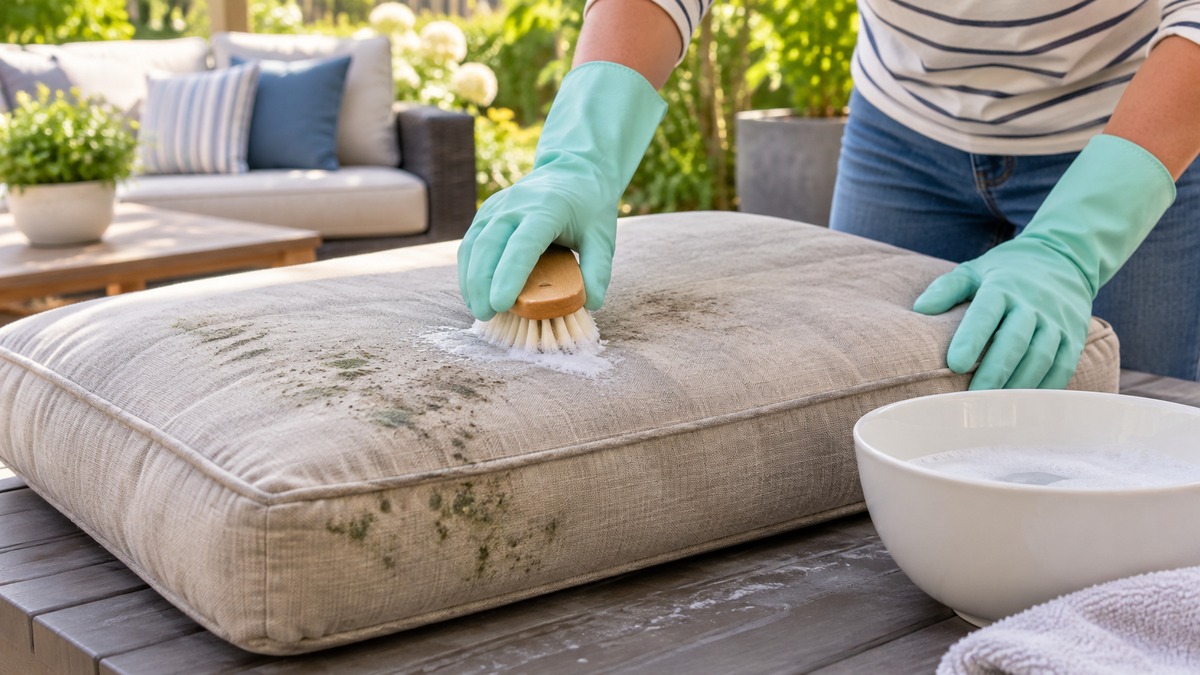
Protection comes before scrubbing. EPA’s list is short: “Gloves, goggles, N-95 respirator.” It also says “Avoid breathing in mold or mold spores.” For gloves, EPA advises “Wear gloves. Long gloves that extend to the middle of the forearm are recommended.” The mask has to fit to work, and EPA says so directly: “In order to be effective, the respirator or mask must fit properly, so carefully follow the instructions supplied with the respirator.”
The University of Georgia list adds clothing and eye protection. Its list “includes rubber gloves, eye goggles (preferably without vents), outer clothing that can be easily removed and/or discarded, and a filter dust mask.” EPA’s cleanup page also says “Avoid exposing yourself or others to mold.” That line covers the people around you as well as you.
Dead mold deserves attention too. EPA warns that dead mold can still cause allergic reactions in some people. Killing the growth does not remove the material, so the goal is to take the mold off, not only to kill it.
Clean the hard parts and frames
Hard surfaces are the easy case. EPA says “Scrub mold off hard surfaces with detergent and water, and dry completely.” The University of Georgia publication says the same in its own words: “Scrub mold off with detergent and water and then dry completely.” It adds that “After cleaning hard surfaces, you may choose to disinfect them.” That step applies to hard surfaces, so do not carry it over to fabric.
For disinfecting hard parts, the University of Georgia gives a dilution: “Mixing 1/4 to 1/2 cup of bleach per gallon of water provides an effective disinfectant solution.” That number is for hard surfaces only, and the EPA caution in the next section still applies. Let the cleaned part dry fully before the cushion goes back on the frame.
Bleach, ammonia and fabric care
Bleach needs care. EPA says “The use of a chemical or biocide that kills organisms such as mold (chlorine bleach, for example) is not recommended as a routine practice during mold cleanup.” Its warning on mixing is firm: “Never mix chlorine bleach solution with other cleaning solutions or detergents that contain ammonia because toxic fumes could be produced.” The University of Georgia repeats the mixing rule as “never mix bleach and ammonia,” and North Dakota State University Extension adds a fabric caution: “Do not use laundry bleaches on materials that will be damaged or might fade.”
Put those sources together and the fabric picture is unclear. None of them gives a cleaner that is safe for outdoor cushion fabric. NDSU also warns that “Don’t mix cleaning products. A combination of chemicals can give off toxic fumes.” The practical step is to read the cushion’s care label and follow the maker’s instructions before you try any cleaner, because the mold pages do not replace those instructions.
When the cushion goes in the bin
Some cushions cannot be saved. The University of Georgia publication says “Discarded items should be enclosed in plastic bags or wrapped in plastic sheets to prevent more contamination.” Wrap the cushion before you carry it away, so spores do not spread across the patio or into the house.
If you are unsure whether a cushion is worth keeping, the sources give you two markers: how long it stayed wet, and whether the mold has gone deep into the material. If you are choosing replacements, outdoor bench cushions compared is a useful next step, and patio furniture and cover options compared covers the protection side.
Keep the next season dry
Prevention in these sources comes back to timing. A cushion should be fully dry before it is stored or covered, because the drying windows above apply to any damp item. The sources do not give a storage container or spot for cushions, so this guide does not name one. If you are looking at furniture that suits a smaller patio, see outdoor furniture for small spaces before you buy a new set.
When to get help from a specialist
Some cushions are worth a professional look, and EPA says so directly. Its cleanup page says “If you are unsure about how to clean an item, or if the item is expensive or of sentimental value, you may wish to consult a specialist.” The same page adds “Look for specialists who are affiliated with professional organizations,” and “Be sure to ask for and check references.” The sources do not name a specialty for outdoor cushions, so ask a restorer or cleaner which materials they handle.
A larger mold problem moves the job beyond this guide. EPA points bigger problems to its remediation guide for schools and commercial buildings, which it says applies to houses as well. Treat the 10-square-foot line as the signal to get more help, rather than a reason to start a large job yourself.
How we chose
We chose sources that give written mold cleanup or drying advice from a federal agency or a university extension service, and that we could open and read on 2026-10-21. Four pages met that test. The two EPA pages, a mold cleanup page and a brief guide, come from the same agency, so we count them as one publisher. The University of Georgia Cooperative Extension publication “Removing Mold in Your Home” is hosted on a Douglas County, Georgia, government site. The North Dakota State University Extension item is a 2009 flood salvage release, and we used it with that date in mind. We left out retailer blogs, pages that returned access errors, and archived copies. This article is an organizing guide, and it recommends no product.
What we could not verify
None of these four pages covers outdoor cushions. The advice comes from general mold guidance for homes and from flood-damaged goods, so apply it with care to fabric and foam.
What the sources do not say
- They do not name outdoor cushion fabric, foam or covers, so no source confirms how those materials respond to cleaning.
- They do not name a cleaner that is safe for outdoor cushion fabric, and they give no bleach ratio for cushions.
- They do not give a way to judge dryness inside a foam core.
- They do not state how much mold a cushion can carry before it has to be discarded. EPA’s 10-square-foot figure is written for homes.
- The NDSU release dates from 2009 and is about flood cleanup, so its wording may not match current practice.
Frequently asked questions
Can I clean mold off an outdoor cushion with bleach?
EPA does not recommend chlorine bleach as a routine mold cleanup step. The University of Georgia publication gives a bleach dilution for disinfecting hard surfaces. Neither source gives a fabric method, so read the cushion’s care label before you use any bleach, and never mix it with ammonia-based cleaners.
Is a small patch of mold something I can clean myself?
EPA says a moldy area under about 10 square feet can usually be handled by the homeowner, and it points larger problems to professional guidance. Wear gloves, goggles and an N-95 respirator while you work, and make sure the mask fits.
When should I throw a cushion away?
Throw away a cushion that you cannot dry within the 48-hour window, or one with severe mold that has gone deep into the material. The University of Georgia publication says severely damaged items should be thrown away. Wrap the discarded cushion in plastic before you move it.
Do I really need a mask for mold on a cushion?
EPA lists an N-95 respirator among its protections and says to avoid breathing in mold or mold spores. The mask only helps if it fits properly, so follow its instructions. The sources do not say whether a mask is required for one small cushion.
Is dead mold still a problem?
According to EPA, dead mold can still set off allergic reactions for some people. The aim, then, is removal rather than killing alone, and the sources give no shortcut that skips the cleanup.
Sources
- https://www.epa.gov/mold/mold-cleanup-your-home (opened 2026-10-21)
- https://www.epa.gov/mold/brief-guide-mold-moisture-and-your-home (opened 2026-10-21)
- https://douglascountyga.gov/DocumentCenter/View/78/Removing-Mold-PDF (opened 2026-10-21)
- https://www.ag.ndsu.edu/news/newsreleases/2009/march-26-2009/ndsu-offers-flood-salvage-tips (opened 2026-10-21)