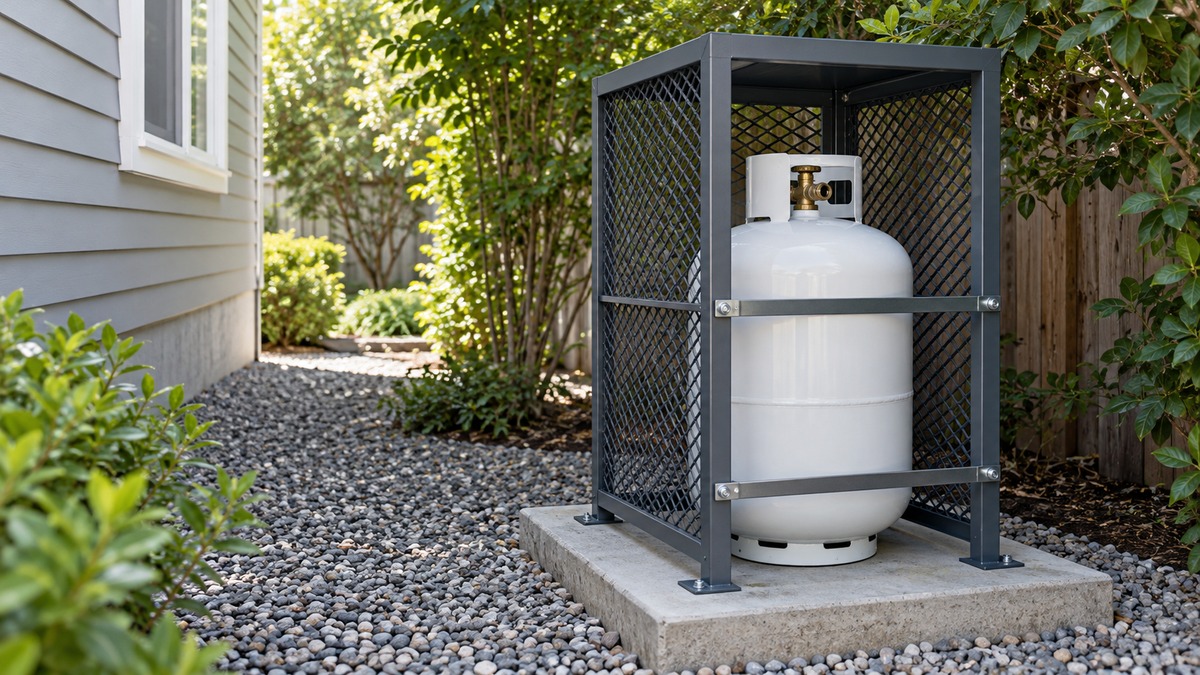
How to Store a Propane Tank Safely
As an Amazon Associate we earn from qualifying purchases.
Knowing how to store a propane tank safely comes down to a few habits: keep it outdoors, keep it upright and secured, keep it away from heat and building openings, and close the valve. Four government and university sources agree on those basics, although they set different distances from doors and windows. This guide turns those rules into steps you can check at home. Your local fire code and the manual for your equipment still decide the final details.
Quick answer
- Store the cylinder outdoors, upright and secured. San Francisco Fire says “Always use or store cylinders in a secure and upright position outdoors (not in a garage or shed).”
- Keep it away from building openings and ignition sources. Massachusetts says to keep propane “at least 10 feet away from building openings such as doors, windows and dryer vents.”
- Close the valve and check connections for leaks without a flame. Massachusetts describes a soapy-water check, but the New Jersey brochure warns against some soap solutions, so read the caution below.
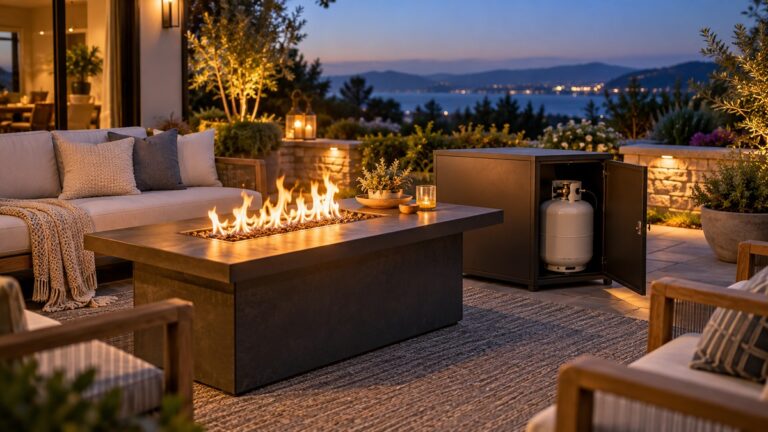
- For spare cylinders in a building, the University of Texas procedure calls for a lockable, ventilated metal locker or rack.
Why outdoors and upright are the core rules
Three of the four sources put the same rule first. San Francisco Fire says “Store propane cylinders outdoors in an upright (vertical) position.” Massachusetts tells readers to “Store propane cylinders upright in an outdoor, shaded area.” The New Jersey brochure, written for construction sites, says “Store and use cylinders in an upright position with protective collars in place.” The University of Texas procedure is written for campus buildings and grills, and it reaches the same place by requiring a locked, ventilated enclosure for stored cylinders.
The sources state the rule more often than they explain it. None of the four pages gives a detailed reason for the outdoor rule beyond the instructions above, so this guide does not add one. The practical message is that a cylinder belongs in open, ventilated air, not in an enclosed space where a leak could collect.
Pick a spot outdoors that stays cool
A storage spot needs to be outdoors, shaded where possible and clear of heat sources. Massachusetts says to store cylinders “upright in an outdoor, shaded area.” San Francisco Fire warns to “Use, store, or transport propane cylinders near high temperatures (this includes storing spare cylinders near the grill).” That warning covers spares as well as the tank in use, so a second cylinder should not sit beside a hot grill or heater.
Distance rules are where the sources differ most. Massachusetts says “Keep all propane outdoors, at least 10 feet away from building openings such as doors, windows and dryer vents, and 20 feet away from air intake vents and ignition sources.” The University of Texas procedure sets a different figure for stored cylinders awaiting use, requiring “a minimum of five (5) feet from any doorway of opening in a building frequented by the public where occupants have at least two means of egress.” The New Jersey brochure adds a rule for combustible material near a tank: “Combustible material must not be stored within 10 feet of the tank.” These figures come from different documents with different scopes. The sources do not reconcile them, so check your local rule before you place a tank.
Keep the cylinder upright and secured
An upright cylinder is less likely to fall, shift or leak at the valve. San Francisco Fire says “ALWAYS transport & store a cylinder in a secure and upright position so it will not fall, shift or roll.” The New Jersey brochure asks for the same thing in its own words: “Make sure cylinders are located or secured to prevent tipping.” It also asks owners to keep the protective collar in place while a cylinder is stored or used.
The University of Texas procedure gives the most detail on moving a cylinder. It says that cylinders “shall be secured in position to minimize the possibility of movement, tipping and/or physical damage” and it asks that a vehicle carry cylinders “positioned in the upright or vertical position.” A cylinder that is secure in a car is still in a vehicle, so the Massachusetts instruction applies as well: “do not leave cylinders in a vehicle.”
Close the valve and protect the fitting
Closing the valve is the simplest step, and it matters every time the tank is not in use. San Francisco Fire tells grill owners to “Turn off the burner control and close the cylinder valve.” The New Jersey brochure says “Make sure cylinder valves are closed and protective caps or collars are in place.” It adds that “A good practice is to plug or cap all cylinder valves when not in use.”
San Francisco Fire also says to protect the hose end when a grill goes unused for a long time: “cover disconnected hose-end fittings with plastic bags or protective caps.” Those covers keep dirt out of the fitting. They do not replace the valve closing, so do both.
Check for leaks without a flame
Leak checks are where the sources give the sharpest warnings. Massachusetts describes a soapy-water method: “Detect leaks by dabbing the connections with a solution of soapy water” and watching for bubbles. San Francisco Fire is clear that a flame is the wrong tool: “Use matches or lighters to check for propane leaks.” appears on its list of things not to do, and Massachusetts says the same about matches and lighters.
The New Jersey brochure goes further on the soap solution. It says “Check all cylinder connections for leaks with a suitable leak detector solution,” and it adds the caution “Do not use a soap solution as some soaps contain corrosive elements”. Massachusetts and New Jersey therefore disagree about soapy water. The safe reading from these pages is to use a leak detector solution that is suitable for gas, as New Jersey recommends, and to avoid any flame. The sources do not say which soaps are safe to use, so the guide does not name one.
Store spare cylinders in a locker or rack
Spare cylinders need more than a corner of the yard. The University of Texas procedure requires storage in a “lockable, ventilated metal locker or rack that prevents tampering with the valves and pilferage of the cylinders.” The same procedure says that racks “shall be locked at all times.” The procedure is for a campus, but its idea of protection from tampering also fits a backyard, where children and visitors can reach a cylinder.
San Francisco Fire warns that the cylinder is not a toy: “Allow children to tamper with the cylinder or grill.” That is a reason to keep a cylinder out of reach and locked away, the same reason the University of Texas gives for its rack. Keep the valve closed and the caps on before it goes into the locker.
When a grill or patio heater goes into storage, the University of Texas procedure says the cylinder should come off first: “Propane cylinders shall be removed from grills and patio heaters prior to storage of the grills or heaters.” The grill or heater itself should then be cooled and kept in a lockable space, according to the same procedure.
Moving a cylinder home
Most cylinders travel before they are stored. San Francisco Fire says that when you replace one, you should “transport in a secure, upright (vertical) position in a well-ventilated area in your vehicle, and take it home immediately.” The University of Texas procedure asks for a leak check before loading: “Cylinders shall be checked and determined to be leak-free prior to being loaded into vehicles.” Massachusetts warns against leaving one in a car, so the trip should go straight home.
Check the cylinder before it goes into storage
A cylinder that is damaged should not be stored at all. San Francisco Fire says “NEVER use a damaged cylinder or a cylinder that has been in a fire.” Massachusetts adds that propane cylinders that are “old, rusty, or showing any other signs of disrepair” should be replaced. San Francisco Fire also notes that “The last inspection date is stamped on the cylinder.” Look for that date before you store it.
Keep your hands off the hardware. San Francisco Fire advises owners not to modify or repair valves, regulators or other cylinder parts, and to take a problem to a qualified service technician. This guide cannot judge a specific tank, so the manual that came with the equipment is the next check.
If you smell gas
A gas smell during storage calls for immediate action, and the sources agree on the order of steps. San Francisco Fire says that if you smell gas, and it is safe to do so, you should “turn off the cylinder valve, turning it to the right (clockwise).” If you cannot close the valve, it says to leave immediately. Its instruction is to “Immediately leave the area and call 9-1-1.” Massachusetts also says “Do not smoke while handling a propane cylinder.” That applies every time you touch the tank.
Mistakes to avoid
- Storing the tank in a garage or shed. San Francisco Fire says to keep cylinders outdoors, not in a garage or shed.
- Keeping a spare beside the grill. The same fire guidance warns against storing spare cylinders near high temperatures.
- Checking for leaks with a lighter. San Francisco Fire and Massachusetts both say to use no flame for leak checks.
- Leaving the valve open or the fitting bare. New Jersey advises closing the valve and plugging or capping it when not in use.
- Using one distance for every case. The University of Texas and Massachusetts figures differ, so read the rule that fits your setting and your local code.
For a full look at what a tank supports, see our propane tanks for gas fire pits comparison, and for patio heater cylinders see 20 lb propane tanks for patio heaters. If your storage question is about where the fire pit itself should sit, the fire pit guide for patios and backyards covers that setup.
How we chose
We chose the pages that give written storage rules for propane cylinders, come from a fire department, a state agency or a university, and that we could open and read on 2026-10-21. Four pages met that test: San Francisco Fire Department’s grill and cylinder safety page, Massachusetts’s grilling safety page, a University of Texas at Austin fire prevention procedure, and a New Jersey Department of Community Affairs brochure. Each is quoted only where its text supports the point. We left out a commercial storage blog, because its figures come from a company rather than a fire authority. Several state fire code pages returned errors when opened, so they are not used. The New Jersey brochure is written for construction sites, and the University of Texas procedure for a campus, so we note their scope where it matters. This is an organizing guide, and it recommends no product.
What we could not verify
This section lists what the sources do not establish. Use it to decide what to check locally before you store a tank.
What the sources do not say
- The sources do not give a temperature figure for “high temperatures.” They say to keep cylinders away from heat without a number.
- The distances in Massachusetts and at the University of Texas come from different situations, and the sources do not say which applies to a home backyard.
- None of the four pages gives a rule for storing an empty cylinder, so this guide does not make one.
- The sources do not describe winter storage or how cold weather affects a cylinder in storage.
- The sources do not describe the construction, size or material of a locker beyond “lockable, ventilated metal locker or rack.”
- No page addresses a specific tank model, so the manufacturer manual for your equipment should be the final check.
Frequently asked questions
Can I store a propane tank in the garage?
No, according to San Francisco Fire, which says cylinders should be stored outdoors and not in a garage or shed. The other pages agree that the outdoor setting is the baseline rule.
Should a propane tank be stored lying down?
The sources say upright. San Francisco Fire, Massachusetts and the New Jersey brochure all say to keep the cylinder upright, and the University of Texas procedure requires an upright position for transport.
How far should a propane tank be from the house?
Massachusetts advises at least 10 feet from doors, windows and dryer vents, and 20 feet from air intake vents and ignition sources. The University of Texas procedure sets 5 feet from a building doorway for stored cylinders in a locker or rack. Because these figures differ, check the rule that applies where you live.
How do I check a propane connection for a leak?
Massachusetts describes a soapy-water check, and New Jersey recommends a suitable leak detector solution. Both reject a flame. New Jersey also warns that some soaps contain corrosive elements, so use a gas leak detector solution where you can.
Does an empty propane tank need the same storage?
None of the four pages addresses empty tanks, so this guide cannot say. Store any cylinder outdoors and upright, as the pages describe for cylinders in general, and check with your local fire authority for any empty-tank rule.
Sources
- https://sf-fire.org/node/416 (opened 2026-10-21)
- https://mass.gov/info-details/grilling-safety (opened 2026-10-21)
- https://fireprevention.utexas.edu/sites/default/files/FPS-SOP%2058-02%20Procedures%20for%20the%20Use%2C%20Storage%20and%20Transportation%20of%20Propane%20Grills%2C%20Patio%20Heaters%20and%20Cylinders.pdf (opened 2026-10-21)
- https://www.nj.gov/dca/codes/publications/pdf_lpg/brochure_useoflpgas.pdf (opened 2026-10-21)