Making Compost in a Tumbler
As an Amazon Associate we earn from qualifying purchases. Details
Making compost in a tumbler comes down to four jobs: load it with a mix of kitchen scraps and dry material, keep that mix as damp as a wrung-out sponge, turn it often enough to bring in air, and stop adding once it is full so the batch can finish. This guide walks through each job with figures from the EPA, Clemson Extension, University of Maryland Extension and Oregon State Extension, then points out where those sources disagree with the claims printed on tumbler listings.
Quick answer
- Load browns and greens together. Browns are dry, carbon-rich material such as dry leaves, shredded cardboard and untreated wood chips. Greens are scraps, grass clippings and coffee grounds. The EPA says to add at least two to three times the volume of browns to greens.
- Check moisture. Clemson and Maryland Extension both describe the target as moist like a wrung-out sponge, not soggy.
- Turn it. Clemson suggests turning a pile once a week. Maryland Extension adds a warning that a tumbler can turn soppy and anaerobic when it holds too many kitchen scraps, and the fix is dry browns.
- Treat it as a batch. When the drum is full, stop adding material and let it finish. The EPA says to let a pile cure for at least four weeks once it stops heating and no food scraps show.
What a tumbler does well, and what it does not
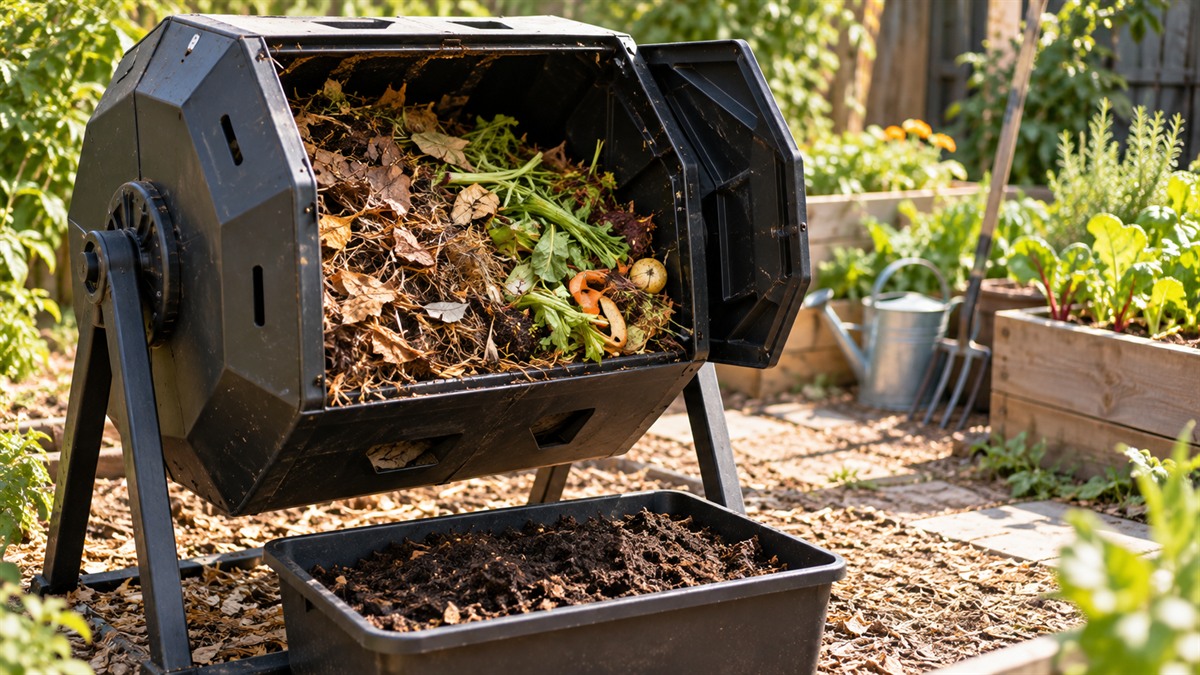
A tumbler is a closed drum on a stand or frame that you rotate by hand. Clemson describes it as a single rotating bin that aids aeration, and it notes that material may slide instead of mixing, so interior baffles can help. Maryland Extension lists the upsides as neat, good aeration and a fit for small spaces. It also lists the downsides: it is costly, usually too small for hot composting, and needs close attention.
That last point matters for expectations. Maryland Extension gives a minimum of 3 ft x 3 ft x 3 ft (27 cubic feet) for a hot bin, and an Ask Extension answer says units above 15 cubic feet retain heat better while smaller ones may not heat thoroughly. The tumblers in this guide are much smaller than either figure, as the table below shows, so plan on a slower, cooler batch rather than a hot one. Maryland Extension gives about a year for cool composting and six to eight weeks plus about two weeks of curing for hot composting.
How big are the tumblers on the market?
Listing capacities are in gallons. One US gallon is about 0.134 cubic feet, so the conversion below is our own arithmetic from the listing figures.
| Tumbler | Listed capacity | Approx. cubic feet | Chambers |
|---|---|---|---|
| Miracle-Gro dual chamber | 37 gallons (2 x 18.5 gal in the title) | about 4.9 | 2 |
| VIVOSUN dual rotating | 43 gallons | about 5.7 | 2 |
| Compost Wizard Jr. | 50 gallons (listing also says 7 cubic feet) | about 6.7 | 1 |
All three are below the 15 cubic feet mentioned in the Ask Extension answer, and far below Maryland Extension’s 27 cubic feet for hot composting. That does not make them poor choices. It means their listing language about speed should be read as a claim and not as a promise. The Miracle-Gro listing says compost in 4 to 6 weeks. The EPA says a well-maintained pile is ready in about three to five months, and Maryland Extension says cool composting takes about a year. Those timelines are for piles, not tumblers specifically, but they are the independent figures available.
Worked example: how fast does a chamber fill?
This is a planning example with an assumed input, not a measured result. Say your kitchen produces one 2-gallon bucket of scraps a week. The EPA rule of two to three parts browns to one part greens by volume means 4 to 6 gallons of browns for that bucket, so about 6 to 8 gallons of mixed material goes in each week. An 18.5-gallon chamber, the size of one side of the Miracle-Gro, holds about 2.3 to 3.1 weeks of that mix if filled to the very top (18.5 divided by 8, and 18.5 divided by 6). Leaving headroom for mixing shortens that, so expect to switch sides every two to three weeks, and plan where the second batch of dry browns will come from before the first side is full.
Step by step
1. Choose a spot
The EPA advises a spot that is easy to reach year-round, drains well and is near a water source. Sun or shade both work. Oregon State Extension notes that liquid can leak from a tumbler, especially with many food scraps or grass clippings, so set the unit where a little dark liquid on the ground is acceptable.
2. Start with browns
Oregon State Extension suggests starting with dried deciduous leaves or straw to absorb liquid, then adding food waste as it is produced. The EPA recommends covering food scraps with four to eight inches of dry leaves or other browns in a pile. In a drum you cannot measure inches, but the idea carries over: scraps should never sit as a wet layer on their own.
3. Add greens in small pieces
The EPA says to chop tough scraps into smaller pieces. Its greens list includes fruit and vegetable scraps, grass clippings, coffee grounds and paper filters, crushed eggshells and paper tea bags without staples. Maryland Extension warns against tea bags that contain plastic.
4. Mind the ratio, and know which ratio you are using
Two different ratios appear in the sources, and they use different units.
- The EPA gives a volume rule: two to three parts browns to one part greens by volume.
- Clemson and Maryland Extension give a weight target of 30 parts carbon to 1 part nitrogen. Clemson’s table lists fall leaves at 30 to 80:1 and grass clippings at 15 to 25:1, and fruit and vegetable scraps at 15 to 20:1.
For a home drum you will not weigh anything. The volume rule is the practical one, and the 30:1 figure explains why dry browns balance wet scraps.
5. Keep it damp, not wet
Maryland Extension says to add water at weekly intervals in dry weather. A tumbler is closed, so the more common problem is too much moisture from scraps. If the mix is soggy, add dry browns, as Maryland Extension advises for a soppy, anaerobic tumbler.
6. Turn on a schedule
Clemson recommends turning a pile about once a week. Maryland Extension says a hot pile should be turned before its temperature drops below 100 F, which is a hot-pile rule. The sources do not give a tumbler-specific schedule, so a practical approach is to start with the weekly turning Clemson gives and add a few rotations after each new load. Whichever rhythm you choose, write it down so it does not slip.
7. Switch to a second chamber or stop adding
Dual-chamber designs let you fill one side while the other finishes. Single chambers such as the Compost Wizard Jr. run as a batch: fill, then stop adding. The Oregon State advisor often moves partly decomposed material into a hot compost pile to finish, which is a sensible fallback if the drum is slow.
What to keep out
The EPA lists meat, fish and bones, cheese and dairy, and fats, oils and grease as items that can attract animals. It also lists diseased or pest-infested plants, weeds with seeds, herbicide-treated grass and plants, pet waste, cat litter, dryer lint, glossy paper and produce stickers. It says compostable foodservice ware and compostable bags generally do not break down in a backyard pile because it does not get hot enough. Maryland Extension’s avoid list adds petroleum products, plastic, synthetic fabrics and soil.
Troubleshooting
| Symptom | Likely cause (source) | What the sources say to do |
|---|---|---|
| Bad smell, soggy mix | Too wet or too few browns (EPA, Maryland, Clemson) | Add dry browns and turn |
| Ammonia smell | Too much nitrogen, such as grass clippings or scraps (Clemson, Maryland) | Break up clumps, add browns, turn |
| Nothing seems to happen | Too dry, too small, or too few greens (EPA, Clemson) | Moisten, balance browns and greens, chop larger pieces |
| Pests drawn in | Meat, dairy or oily food (Clemson, EPA) | Remove those items and keep scraps covered with browns |
| Dark liquid dripping | Wet scraps or clippings (Oregon State Extension) | Add dry material; expect some leakage |
Tumblers and tools worth checking
Specs below come from the Amazon listings and were checked on 2026-10-18.
VIVOSUN Outdoor Tumbling Composter, 43 Gallon (dual rotating chamber)
Specs from the listing (checked 2026-10-18):
- Capacity: 43 gallons
- Dimensions: 26.25 in L x 23.6 in W x 36.5 in H
- Weight: 21.7 pounds
- Shape: octagonal; eight panels with deep fins
Pros
- Two separate chambers, so one side can finish while the other takes new material
- Listing mentions air vents and deep fins to break clumps
Cons
- Material Type field says galvanized steel, while the bullets describe a metal frame with a PP plastic body
- About 5.7 cubic feet, well under the 15 cubic feet the Ask Extension answer mentions for good heat retention
Best for: A small yard that wants a continuous two-batch rhythm
Skip if: You want a hot, fast pile
View on Amazon (affiliate link)
Miracle-Gro Dual Chamber Compost Tumbler (2 x 18.5 gal)
Specs from the listing (checked 2026-10-18):
- Capacity: 37 gallons (2 x 18.5 gal in the title)
- Dimensions: 25 in L x 23.5 in W x 29.5 in H
- Weight: 17.6 pounds
- Shape: hexagonal; two sliding doors
Pros
- Dual chambers and sliding doors
- Listing describes side-locking mechanisms and tight seals to keep out pests
Cons
- The listing says compost in 4 to 6 weeks, a manufacturer claim that is well ahead of the EPA’s three to five months for a well-maintained pile
- Material Type says alloy steel, while the bullets say galvanized steel base with plastic chambers
Best for: A smaller dual-chamber unit (37 gallons)
Skip if: You expect to hit the listing’s 4 to 6 weeks without close management
View on Amazon (affiliate link)
Good Ideas Compost Wizard Jr. Tumbler (single chamber, 50 gallons)
Specs from the listing (checked 2026-10-18):
- Capacity: 50 gallons; the title says 7 cubic feet
- Dimensions: 22 x 23.5 x 30 inches
- Weight: 27 pounds
- Features: molded handholds that act as agitators, wheeled base, 12 inch twist lids, arrives fully assembled
Pros
- Largest volume of the three, about 6.7 cubic feet by our conversion
- Black drum, which the listing says absorbs heat
Cons
- One chamber, so it runs as a batch
- Bullets call it a single chamber but also mention twist lids on each chamber
Best for: A one-batch-at-a-time routine
Skip if: You want to keep adding scraps during a cure
View on Amazon (affiliate link)
WLSANX Compost Stirring Tool, 33.4 inch (optional add-on)
Specs from the listing (checked 2026-10-18):
- Height: 33.4 inches; 5.9 inches wide at the spiral
- Weight: 4.14 pounds
- Material Type field: cast iron
Pros
- Listing says it is meant for outdoor compost bins and tumblers and adds air by turning a spiral
Cons
- Bullets call it rust and corrosion resistant, while the Material Type field says cast iron
- Whether a drum’s opening is wide enough for a 5.9 inch spiral is not stated
Best for: Loosening a packed mix between rotations
Skip if: Your drum has only a small door
View on Amazon (affiliate link)
Common mistakes
- Loading only kitchen scraps. This is the usual cause of the soppy, anaerobic drum Maryland Extension describes.
- Filling to the brim. A drum packed full leaves no room for material to move when you turn it, which is our reasoning and not a sourced figure. An Ask Extension answer notes that a full unit can hold about 300 pounds, which strains cheap supports and gears.
- Buying on speed claims. Compare a listing’s weeks-to-compost figure with the EPA and Maryland timelines before you set expectations.
- Skipping the stand check. The Ask Extension answer recommends sturdy metal supports and reports that its writer’s nylon gears wore over time.
FAQ
How long does compost take in a tumbler?
Sources vary. The Miracle-Gro listing says 4 to 6 weeks. The EPA says three to five months for a well-maintained pile, and Maryland Extension says about a year for cool composting.
Can I put cooked food in a tumbler?
The EPA says cooked food is acceptable only in small amounts and lists meat, dairy and grease as items to keep out.
How often should I turn it?
Clemson recommends about once a week for a pile. Add a few extra turns after you load new scraps, and use dry browns if the mix looks wet.
Do I need a thermometer?
Not for a small cool batch. Clemson mentions a long-stemmed compost thermometer for checking that a pile has passed 140 F, the level above which it says most harmful pathogens and weed seeds are destroyed.
Does a tumbler attract pests?
The Oregon State advisor says raised tumblers are animal-proof but not insect-proof. Keeping meat, dairy and oily food out helps, per Clemson.
Is a tumbler better than an open bin?
Not in every way. Maryland Extension lists tumblers as neat and well aerated but costly and usually too small for hot composting. Our guide to starting a compost bin covers the other styles.
Keep reading
- FCMP outdoor dual chamber tumbling composter, another tumbler we looked at in detail
- How to use a rotating compost bin
- The best way to start a compost bin
Bottom line
A tumbler works best as a tidy, small-yard batch composter. Load dry browns first, keep the mix damp, turn it on a schedule, stop adding when it is full, and expect months, not weeks, unless your own results say otherwise. If you buy, compare chamber count, volume in cubic feet and the strength of the stand and gears, and read any speed claim against the EPA and Extension timelines above.
Sources
- US EPA, Composting at Home: greens and browns, ratios, what to keep out, timelines, bin types.
- Clemson Extension, Composting: tumbler description, 30:1 carbon to nitrogen, weekly turning, troubleshooting.
- University of Maryland Extension, How to Make Compost at Home: tumbler pros and cons, hot and cool composting, moisture, temperatures.
- Oregon State Extension, Compost tumbler suggestions: supports, drainage, pests, how to start a load.
- Ask Extension, tumbler features: 300 pound loaded weight, 15 cubic foot heat figure, gears and drainage holes. The page does not name the answering institution.